
It is challenging to rank a law firm site, despite having outstanding legal knowledge. Search engines are dominated by bigger companies, the legal keywords are highly competitive, and paid searches can empty wallets without providing long-term growth. At the same time, content publication does not change the ranking much unless you have an authoritative site.
Google, in its own Search documentation, states that its ranking systems consider signals that assist in determining the relevance and trustworthiness of pages, and thus, the authority is a vital element of organic visibility.
It is where the backlinks play a decisive role. High-quality links are considered pointers of credibility, relevance, and trust by search engines, and all legal websites require these three attributes to compete favorably.
Nevertheless, generic SEO strategies are not enough in legal link building. It requires relevance, precision, and an approach that is based on the way legal clients search the web.
This blog describes the way in which lawyers can enhance their search authority by using viable and practical link-building tactics.
Table Of Content
1. Understand Why Link Building Matters For Law Firms
2. Focus On Relevance Over Link Quantity
3. Build Authoritative Legal Content That Naturally Earns Links
4. Use Strategic Outreach To Earn Quality Backlinks
5. Strengthen Local SEO With Community-Based Link Building
6. Avoid Risky Link Building Practices That Damage Legal SEO
7. Track Performance and Refine Your Link Strategy
8. Build Authority That Lasts
1. Understand Why Link Building Matters For Law Firms
Law firms that invest in SEO tend to put a lot of emphasis on content production, technical solutions, and local optimization. Although they are important factors, without indications of authority by other websites, the rankings tend to stagnate.
This is where the link building for lawyers comes in as a strategic advantage.
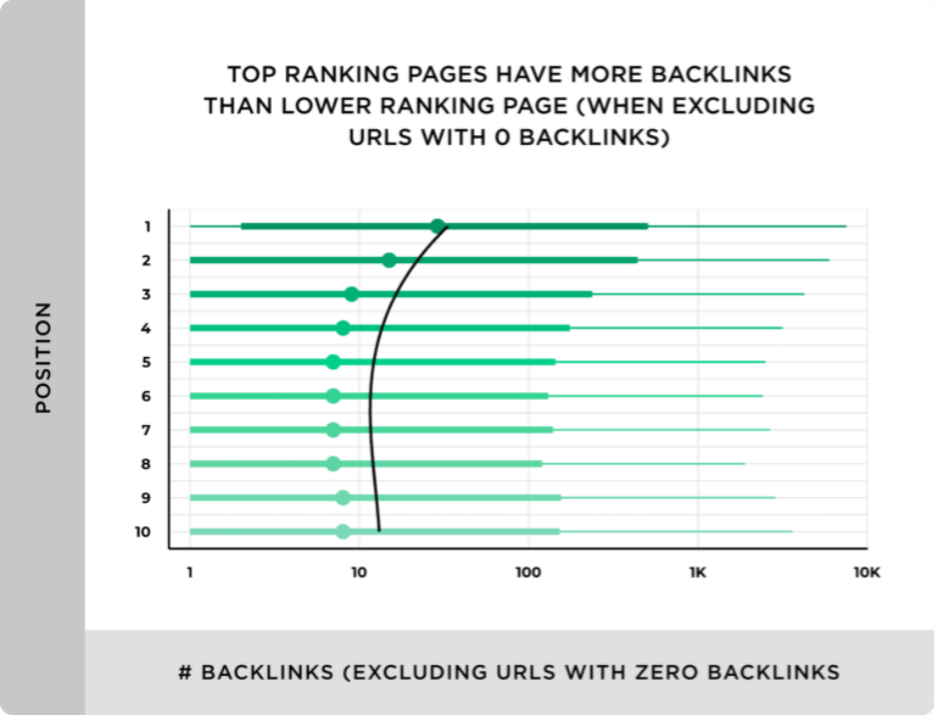
In fact, a study by Backlinko revealed that the number of domains linking to a page has a high degree of correlation to the rankings on Google, meaning that authoritative backlinks are even more valuable in competitive search landscapes.
Backlinks are perceived as a recommendation by search engines. When reputable websites refer to your law firm, it is an indication that your content is worth being seen. As a result, you have better opportunities to rank on competitive legal search terms.
However, not all links carry equal value.
In the case of legal websites, trust is important. A backlink to a reputable legal site, business association, or local newspaper is worth a lot more than dozens of irrelevant directory links.
This is important since legal search is extremely competitive.
Regardless of whether you practice family law, criminal defense, immigration law, or personal injury, potential clients usually start their search online. If your competitors have stronger backlink profiles, they are more likely to outrank you.
Effective link building helps your firm:
- Improve domain authority
- Rank for high-intent legal keywords
- Increase referral traffic
- Strengthen online credibility
- Support local optimization
- Generate long-term lead acquisition
In the absence of backlinks, even high-quality legal information may go unnoticed.
2. Focus On Relevance Over Link Quantity

Another pitfall in SEO is the belief that an increase in backlinks automatically leads to a better ranking. In practice, relevance is much more important than raw numbers.
This is particularly critical in the case of law firms.
A backlink from an authoritative legal directory, bar association resource, law publication, or local business organization can be very valuable. Conversely, the unrelated website links might not be of much use and can also pose SEO risk.
Search engines have become much more skilled at context evaluation.
As an illustration, a personal injury law firm that has gained a mention on a healthcare blog, local accident awareness campaign, insurance publication, or a city news site is much more authoritative than dozens of links on random lifestyle blogs.
Before seeking any backlinks, ask the following questions:
- Is this website relevant to legal services?
- Does the site have genuine traffic?
- Are the materials professionally updated?
- Would a real person click this link?
- Does the link make editorial sense?
When the response is negative, the connection is probably of little strategic value.
Good SEO is not acquired by the accumulation of links, but good relationships.
3. Build Authoritative Legal Content That Naturally Earns Links
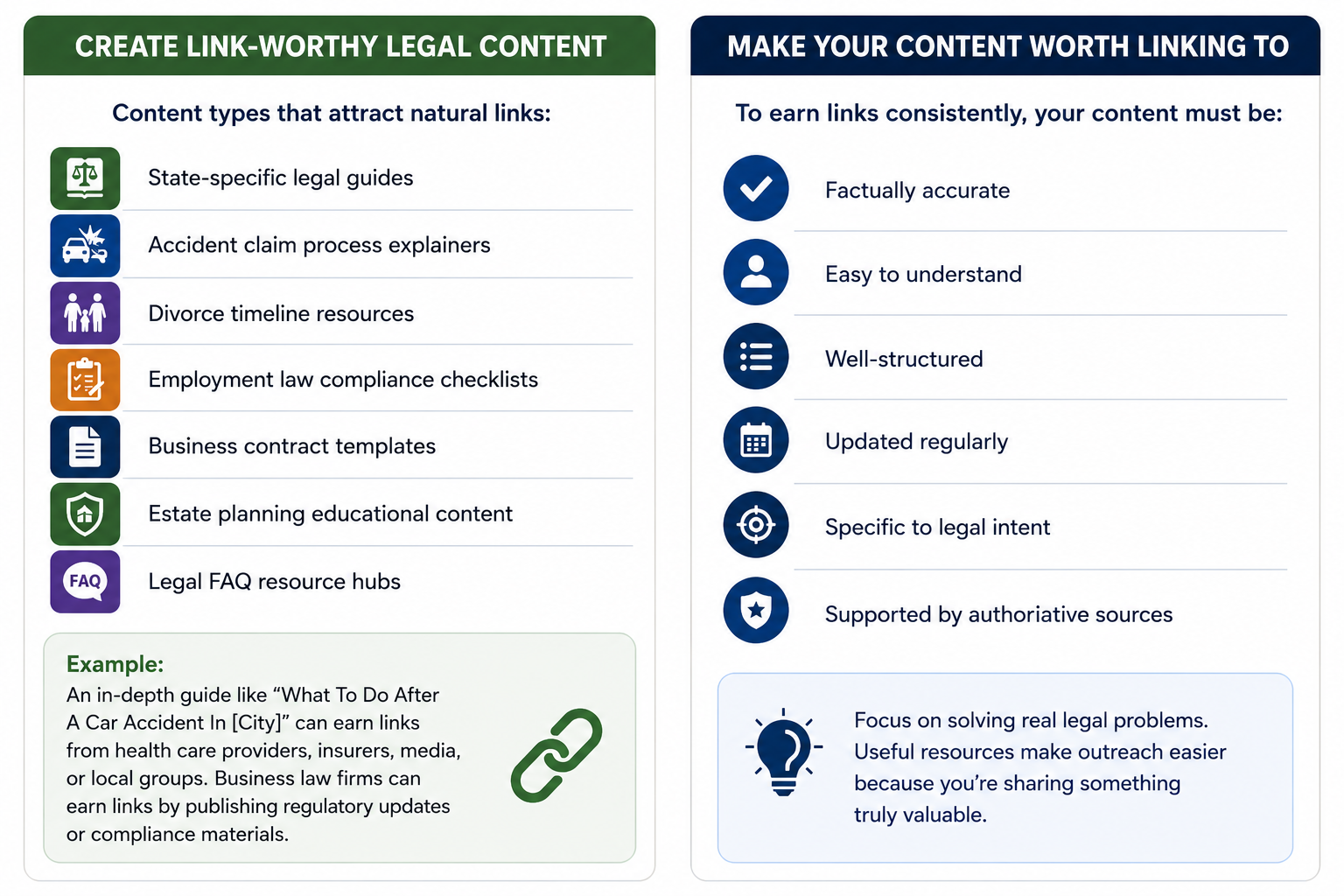 The best backlinks are usually attained rather than demanded.
This occurs when your content becomes helpful to the extent that it is naturally cited by other websites. This presents a great opportunity to lawyers since legal issues tend to be controversial and may require professional judgment.
Potential link-worthy content includes:
- State-specific legal guides
- Accident claim process explainers
- Divorce timeline resources
- Employment law compliance checklists
- Business contract templates
- Estate planning educational content
- Legal FAQ resource hubs
As an illustration, an in-depth tutorial on What To Do After A Car Accident In [City] could be linked with health care providers, insurance information, media, or local groups.
Likewise, business law firms have the opportunity to gain links by publishing regulatory updates or compliance materials.
Nevertheless, superficial content is hardly ever interesting.
In order to attain links regularly, the content must be:
- Factually accurate
- Easy to understand
- Well-structured
- Updated regularly
- Specific to legal intent
- Supported by authoritative sources
That is, content should address actual problems.
When you have useful legal resources on your site, outreach will be simpler since you are marketing something that is really valuable.
4. Use Strategic Outreach To Earn Quality Backlinks
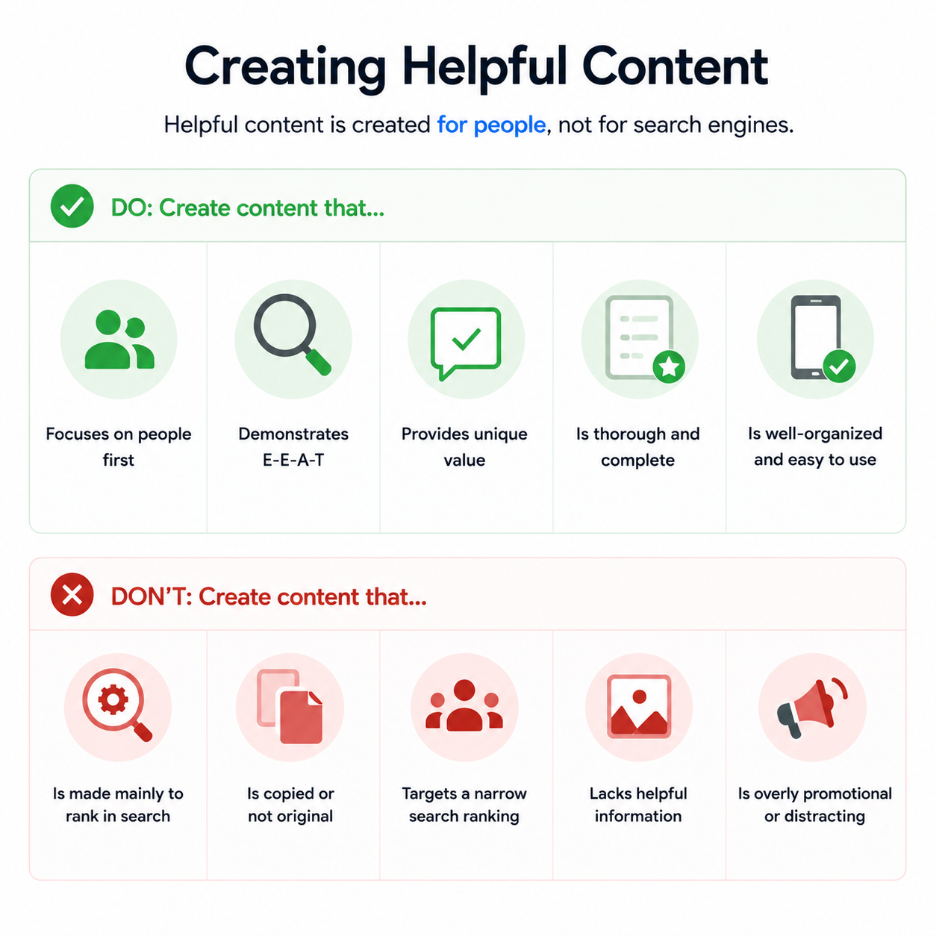
Even outstanding materials tend to require advertising. That is the reason why outreach is one of the fundamental link-building strategies. In fact, the Google Search Central instructions on how to create useful, people-first information strengthen the idea of creating genuinely useful resources that people would be willing to consult, and strategic outreach is a viable method to increase discoverability.
Nevertheless, outreach does not involve mass emailing random websites.
Rather, it consists of finding pertinent publishers, resource pages, local organizations, bloggers, journalists, and industry platforms that would truly appreciate being referenced to your content.
Good outreach opportunities include:
- Legal industry blogs
- Chamber of commerce websites
- Local business publications
- Universities
- Nonprofit organizations
- Legal podcasts
- Community resource pages
As an illustration, when your company releases a guide on workplace harassment law, it would be strategic to contact HR blogs or employment-oriented organizations.
Likewise, a family law firm could pitch educational resources to parenting publications.
Outreach is most effective when the communication is individualized, pertinent, and value-based. Therefore, void transactional messaging.
Furthermore, editors will be much more open when your outreach presents the reasons why the resource will be useful to their audience.
Moreover, outreach based on relationships is more likely to be effective than one-time campaigns.
The development of recurring media and publisher relationships can provide recurring link opportunities in the long run.
5. Strengthen Local SEO With Community-Based Link Building
In most law firms, local presence produces most of the leads.
Therefore, local link acquisition should be a major priority. The localized backlinks assist search engines in relating your law firm to a geographical market.
Local opportunities available practically include:
Local Directories
Pay attention to reliable directories like:
- Bar associations
- Chamber of commerce websites
- Local business directories
- City-specific professional listings
Community Sponsorships
Sponsoring local events would generate quality backlink opportunities.
Examples include:
- Charity fundraisers
- Educational seminars
- Legal awareness campaigns
- School events
- Nonprofit partnerships
Local Media Coverage
Journalists frequently need expert commentary.
Lawyers can contribute insights on:
- Legislative developments
- Legal disputes
- Public safety issues
- Employment law changes
- Regional business compliance
Educational Partnerships
Law firms can collaborate with:
- Universities
- Colleges
- Legal clinics
- Scholarship programs
These opportunities tend to create authoritative local mentions.
Since Google highly emphasizes local relevance, these backlinks may have a great influence on map visibility and local rankings.
More to the point, local connections also enhance the level of trust among real potential customers.
6. Avoid Risky Link Building Practices That Damage Legal SEO
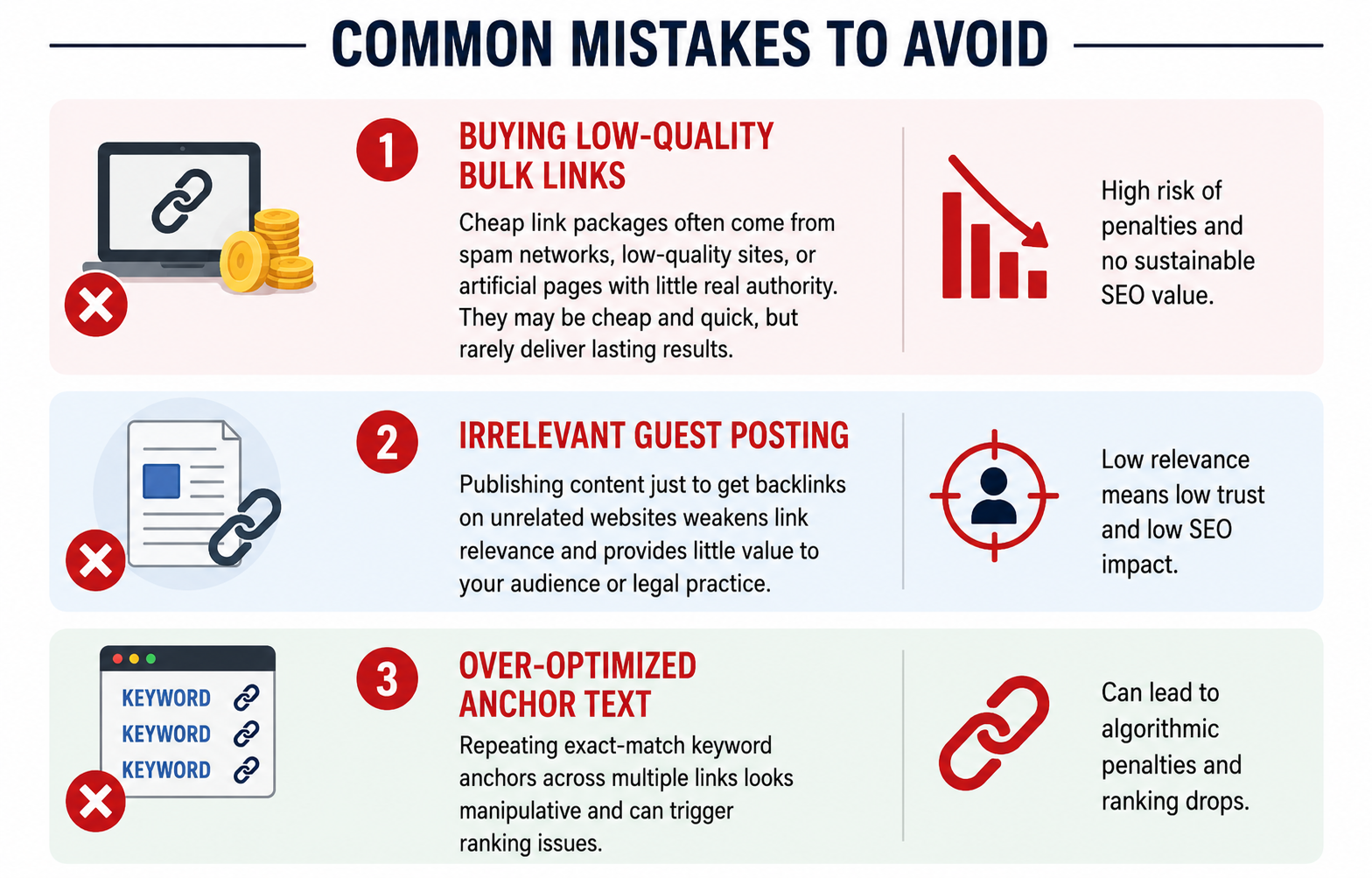 Because legal keywords are valuable, some firms attempt shortcuts. This creates significant long-term risk. According to Google Search Central’s spam policies, link schemes intended to manipulate rankings violate Google’s guidelines and can result in ranking penalties or reduced search visibility.
As a result, search engines penalize manipulative link practices, especially when backlink patterns appear unnatural.
Common mistakes include:
Buying Low-Quality Bulk Links
Cheap link packages often rely on spam networks, low-quality websites, or artificially created pages with little real authority. While these links may appear attractive because of their low cost and quick delivery, they rarely produce sustainable SEO results.
Irrelevant Guest Posting
Publishing content solely to secure backlinks on unrelated websites weakens overall link quality and reduces relevance. Especially when the content offers no contextual connection to legal services or your target audience.
Over-Optimized Anchor Text
Repeated exact-match keyword anchors can appear manipulative. For example, repeatedly forcing the same legal keyword across multiple backlinks can trigger ranking issues.
Additionally, Legal SEO requires credibility. A damaged backlink profile can take months or longer to recover. Therefore, prioritize durable authority-building methods, instead of shortcuts.
Ultimately, long-term rankings are built through trust, not loopholes.
7. Track Performance and Refine Your Link Strategy
Link building should never operate on assumptions.
Therefore, measurement is essential. Without tracking results, it becomes difficult to understand which efforts generate authority, traffic, and leads.
Key metrics to monitor include:
Link Quality
Evaluate each backlink based on authority, relevance, and editorial context rather than simply counting links.
A backlink from a respected legal publication, local news source, or relevant industry website will usually contribute far more SEO value than several low-quality or unrelated links.
Organic Keyword Rankings
Measure ranking improvements across the pages that matter most to your business. This includes service pages, location-specific landing pages, and legal informational content designed to attract potential clients during research stages.
Referral Traffic
Backlinks can deliver value beyond rankings. Some placements drive direct traffic from users who click through to your website, creating an additional source of potential leads. This makes high-quality backlinks especially valuable, as they can support both SEO growth and client acquisition when placed on trusted, relevant websites with engaged audiences.
Lead Conversions
SEO performance ultimately connects to business outcomes.
Monitor:
- Consultation requests
- Contact form submissions
- Phone inquiries
Additionally, data reveals what deserves scaling.
For example, if local media outreach consistently produces quality backlinks and leads, invest more there.
On the other hand, if generic directory listings show limited impact, shifting effort becomes the smarter move. The most effective legal SEO strategies improve through ongoing measurement and refinement.
Build Authority That Lasts
Link building for law firms is not about collecting as many backlinks as possible. It is about building authority where trust matters most.
High-quality legal SEO depends on relevance, credibility, and strategic execution. When your firm earns links from respected legal, local, and industry-relevant sources, search visibility improves more sustainably.
At the same time, poor tactics create avoidable setbacks.
By focusing on authoritative content, strategic outreach, local relevance, and measurable performance, your law firm can build stronger rankings that translate into meaningful client acquisition over time.
FAQs
1. Why is link building important for law firms?
Link building helps law firms improve search engine rankings, build online authority, and attract potential clients through stronger organic visibility.
2. What types of backlinks are best for legal websites?
Backlinks from reputable legal publications, bar associations, local business organizations, news websites, and relevant industry sources offer the most value.
3. Can poor link-building practices hurt a law firm’s SEO?
Yes, tactics like buying low-quality links, irrelevant guest posting, or using manipulative anchor text can lead to ranking penalties and reduced visibility.
4. How can law firms earn quality backlinks naturally?
Law firms can earn quality backlinks by publishing helpful legal resources, creating location-specific guides, and conducting strategic outreach to relevant publishers and organizations.

About the author: Vibhav Gaur, Business Head
Vibhav Gaur leads strategic operations and business growth at the organization. With a strong background in digital transformation and customer-focused solutions, he has helped numerous clients streamline their web presence and scale efficiently. His leadership ensures seamless execution across teams, with a commitment to delivering results and fostering innovation in every project.


