

Quick Summary: Google’s intelligent Search Box matters because it has changed the starting point of search behavior. Users are no longer being forced to click blue links. They are being steered towards AI-supported responses, summaries, and completion of tasks. To achieve organic visibility, this means that it is no longer about being ranked at the top of the page, but becoming the source that AI systems trust, refer to, and bring up.
Key Takeaways
- Google’s intelligent Search Box signals a shift from keyword-based search to AI-powered, intent-driven search experiences.
- AI Mode is changing Search to an action engine, capable of understanding, summarizing, and helping with complex tasks.
- SEO is shifting its principles of rankings and clicks to GEO (Generative Engine Optimization) and is becoming a reliable source of answers provided by AI.
- Publishers are likely to experience a fall in click-through rates as AI-generated responses respond to more queries in Search.
- Brands producing authoritative, structured, and original content are in a better position to gain attention in AI Overviews, AI Mode, ChatGPT, Gemini, and other answer engines.
Over the last 25 years, Google Search has operated on a very basic formula: a user types in a query, and Google provides a list of links, and websites compete to gain visibility by ranking. Although search has been greatly transformed throughout the years, that core experience has not changed much.
Google’s new intelligent search box may be the clearest sign that this era is coming to an end.
Designed to support longer prompts, AI-powered responses, multi-modal inputs, and task-oriented search experiences, the intelligent Search Box represents a broader shift toward AI-first search. Rather than just assisting you to find information, Google is more geared towards assisting you to understand, compare, decide, and act.
For SEO professionals, publishers, and brands, this brings a pertinent question:
“How do you stay visible when search engines are turning into answer engines?”
Table of Content
- What Is Google’s Intelligent Search Box?
- How Does Google’s Multimodal Search Work?
- How Are AI Agents Changing Task Completion in Search?
- How Is AI Mode Different From Traditional Search?
- What Does Google’s Intelligent Search Box Mean for SEO?
- What Does Google’s Intelligent Search Box Mean for Publishers?
- What Does Google’s Intelligent Search Box Mean for Brands and Businesses?
- GEO and AEO: How Should Teams Optimize Now?
- What Content Performs Best in AI-First Search?
- Will AI Search Reduce Website Traffic?
- What Should Businesses Do Next?
- FAQs
- Future of Organic Visibility
What is Google’s Intelligent Search Box?

Google’s Intelligent Search Box is the next stage of Search UI and behavior. It is intended to simplify AI search, provide longer prompts, and more AI-driven options within the search interface.
Practically, the search box is no longer a keyword field, but rather an intelligent layer that can understand what you desire and not what you type.
That distinction matters.
Traditional search presupposes that you already have information about how to formulate the query. Intelligent Search, however, presupposes that you are stating a goal, a task, or a problem, which might require interpretation to generate an answer.
This shift reflects broader changes in how people seek information online.
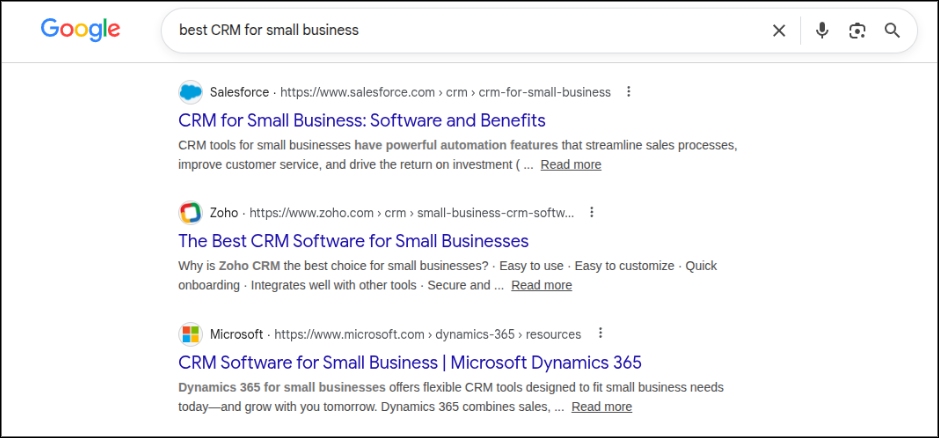
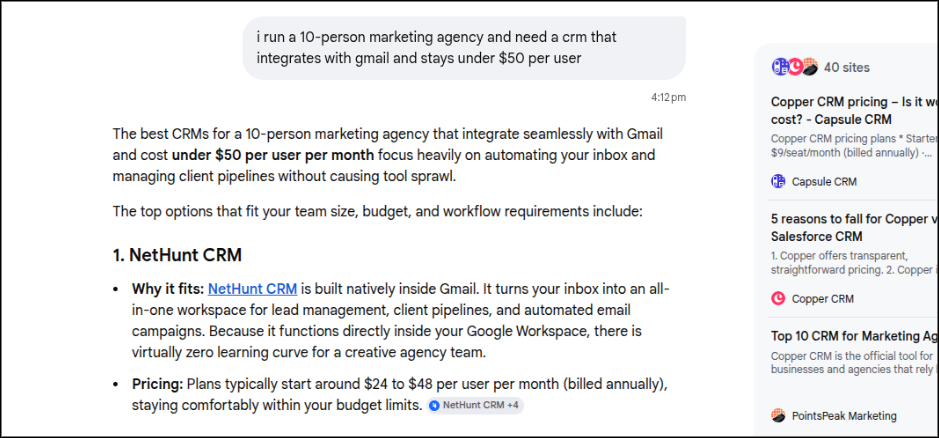
For example, in traditional search, you might type “best CRM for small business” and review multiple webpages to compare options.
With an intelligent Search Box, you can instead ask “I run a 10-person marketing agency and need a CRM that integrates with Gmail and stays under $50 per user—what are my best options?” The AI can interpret the context, understand the requirements, and provide a tailored recommendation, making the search experience more conversational and outcome-driven.
Research by Microsoft and Carnegie Mellon University found that users increasingly interact with generative AI systems through conversational, task-oriented prompts rather than traditional keyword searches.
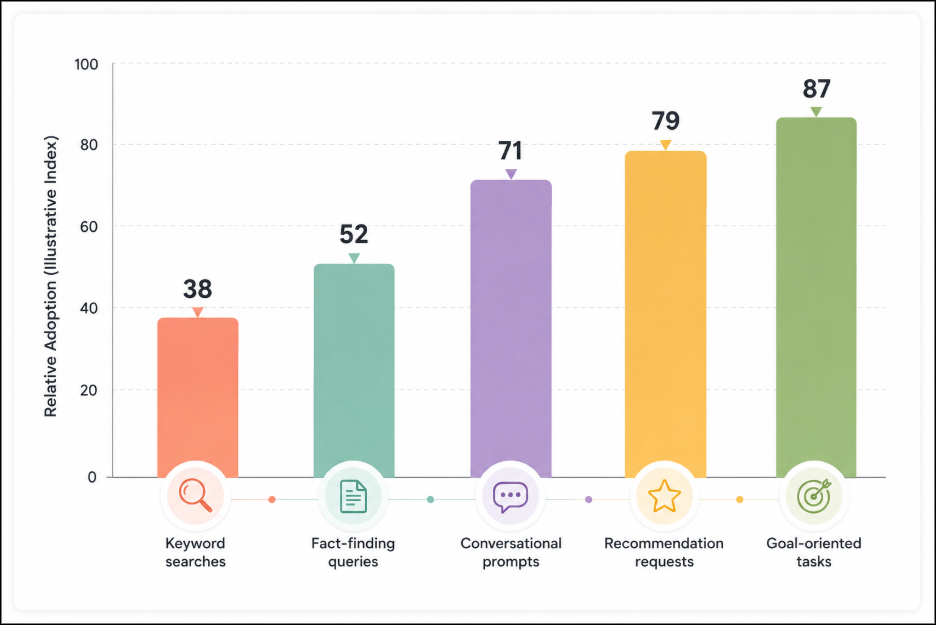
These findings suggest that users are becoming more comfortable describing goals, requesting recommendations, and seeking synthesized answers—behaviors that closely align with Google’s vision for AI-first search.
That said, as AI becomes more deeply integrated into search, you are no longer expected to think like search engines. Instead, search engines are being designed to think more like users, interpreting intent, understanding context, and helping people move from questions to outcomes.
How Does Google’s Multimodal Search Work?
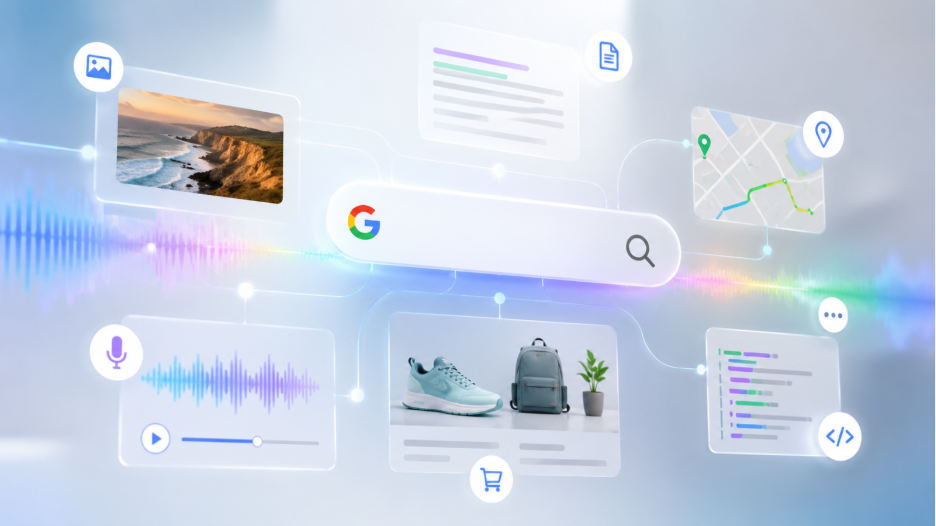 Multimodal search lets you interact with search using more than plain text.
You are able to mix language, pictures, files, screenshots, browser context, and other cues to convey intent in a more natural way. That implies that search is no longer reliant on a limited number of keyword phrases. It is capable of dealing with richer, more ambiguous, and human ways of asking questions.
This is important since what performs well on multimodal search is not necessarily the content that is simply optimized to one single keyword. It is the content that explicitly describes entities, context, relations, and results in a manner that can be understood by machines and relied upon by users.
In the case of content teams, multimodal search sets the bar higher:
- Content must be explicit, not vague
- Answers must be structured, not buried
- Entities must be defined clearly
- Context must be obvious to both humans and machines
How Are AI Agents Changing Task Completion In Search?
The next logical extension of intelligent search is AI agents.
These agents can monitor, compare, summarize, and resume working after the first search session as opposed to responding to one query at a time. That transforms search from a one-time searching experience into a continuous assistance model.
This is a major behavioral change. You may no longer need to repeatedly search for:
- Best tool
- Latest update
- Lowest price
- Newest competitor move
- Strongest option in a category
An AI agent can perform that background monitoring and only come back when something changes, or a decision point emerges.
That changes the value of content. The content that attracts a click is no longer the most useful. It is the content that can nourish an AI workflow with consistent, up-to-date, and relevant information.
How is AI Mode Different From Traditional Search?
The most obvious means of comprehending this AI shift is to make a comparison between the old model and the new one.
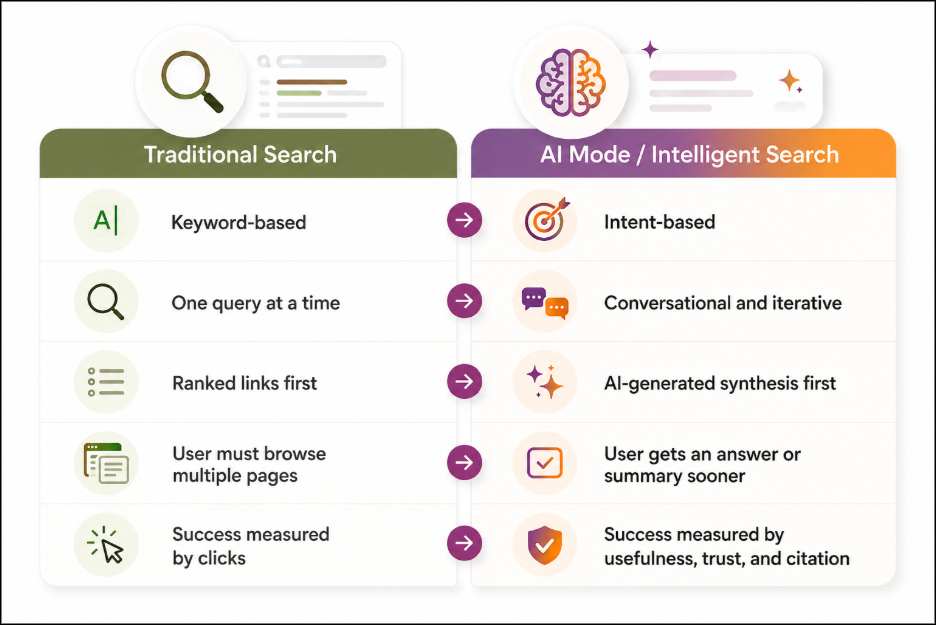
The old form of search is good for retrieval. On the other hand, AI Mode is not meant for only retrieval; it is meant to interpret, synthesize, and act.
This does not imply that there is no classic search. It implies the center of gravity is mobile. The browser and the SERP are still significant, but no longer are the sole locations where search value is generated.
What Does This Mean For SEO?
This is what most SEO teams should consider as a strategic reset.
The process of search optimization is no longer limited to ranking the pages in response to specific search queries. It is now more about being the source that AI systems like to use in producing answers.
This is one reason why organizations closely following the evolution of AI-powered search, including Outreach Crayon, see GEO and AEO becoming increasingly important alongside traditional SEO.
As AI-generated answers occupy more search experiences, brands will need strategies focused on visibility, credibility, and citation potential.
Furthermore, the growing role of AI-driven discovery is also attracting attention from researchers.
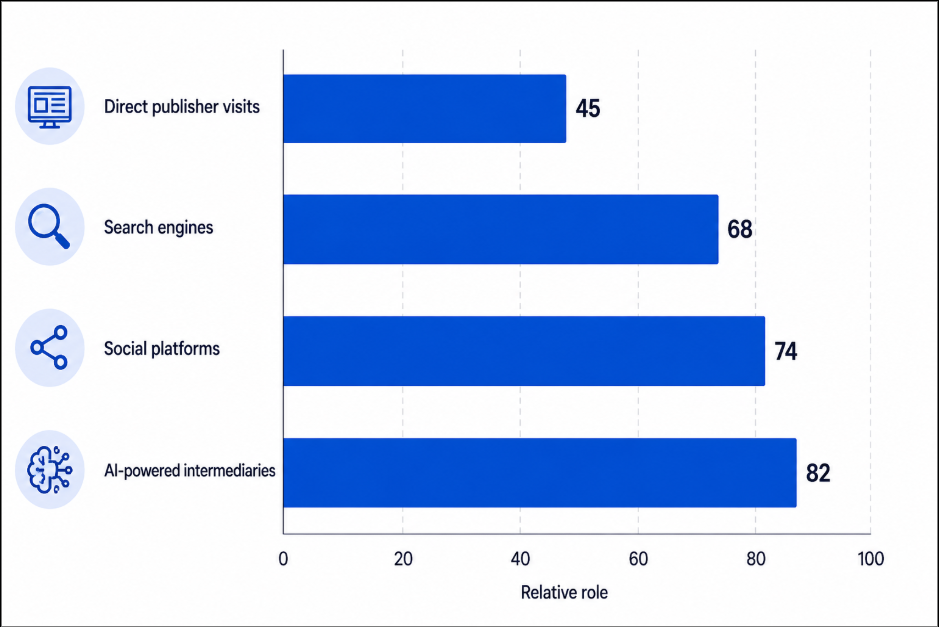
Findings from the Reuters Institute Digital News Report show that audiences increasingly access information through intermediaries rather than directly visiting publisher websites. As AI-generated answers become more common, visibility within those responses may become just as important as traditional search rankings.
Considering that, the practical impact is significant:
1. Rankings Alone Are Not Enough
The high ranking is still worth appreciating, although it does not assure the same number of clicks as before. This is because, when the user is satisfied with the answer provided by an AI before visiting the site, the organic traffic may be reduced despite having visibility.
2. Originality Becomes Moat
AI can more easily summarize generic explanations, and competitors can more easily replicate them. Originally written material, first-party information, proprietary models, and analyst opinion are much more valuable.
3. Structured Content Wins More Often
Clearly defined headings, brief definitions, blocks of comparison, frequently asked questions, and schema-friendly formatting enhance the possibility of content being comprehended and recycled by AI systems.
4. Entity Clarity Matters
The naming and definition of brands, products, services, people, and concepts should be uniform. Clarity of meaning is important to AI systems.
5. Trust Signals Become Strategic
Correctness, the quality of the citation, timeliness, and the authority of the topic are among the factors that lead to the treatment of a page as answer-worthy.
What Does This Mean For Publishers?

The disruption is the most acute to publishers.
When search provides more answers within the interface, fewer users might access the original article. That poses a traffic problem, particularly to publishers whose content is informational and has low differentiation.
Moreover, the risk is not just fewer clicks. It is a structural change in content economics.
Old model was:
Content → Ranking → Click → Ad Revenue or Conversion
New model may become:
Content → AI synthesis → Answer inside search → Reduced click-through
But that does not negate the importance of publishing. It alters the point of capture of the value.
Publishers now need to think in terms of:
- Authority, not volume
- Not only traffic but source value
- Long-term experience, not merchandise knowledge
- Citation potential, not only pageviews
The most resilient publishers will be those which cannot be quickly substituted by AI systems: original reporting, in-depth analysis, research supported by data, and unique editorial opinion.
What Does this Mean for Brands and Businesses?
The opportunity is huge when it comes to brands.
AI-first search is more inclined towards companies that can exhibit expertise, clarity, and trust.
That implies that your site is not a destination anymore. It is a source library that AI systems can learn from when making decisions on what to surface.
Brands that can benefit most are those with:
- Clear service definitions
- Strong topic authority
- Structured educational content
- Case studies and proof points
- Detailed product and service pages responding to actual questions.
- Unique data or insights
And this is where GEO and AEO come into play.
The goal is not simply to “write for AI.” In fact, the Aim is to ensure that your business is easy to know, believe, and refer to.
GEO and AEO: How Should Teams Optimize Now?
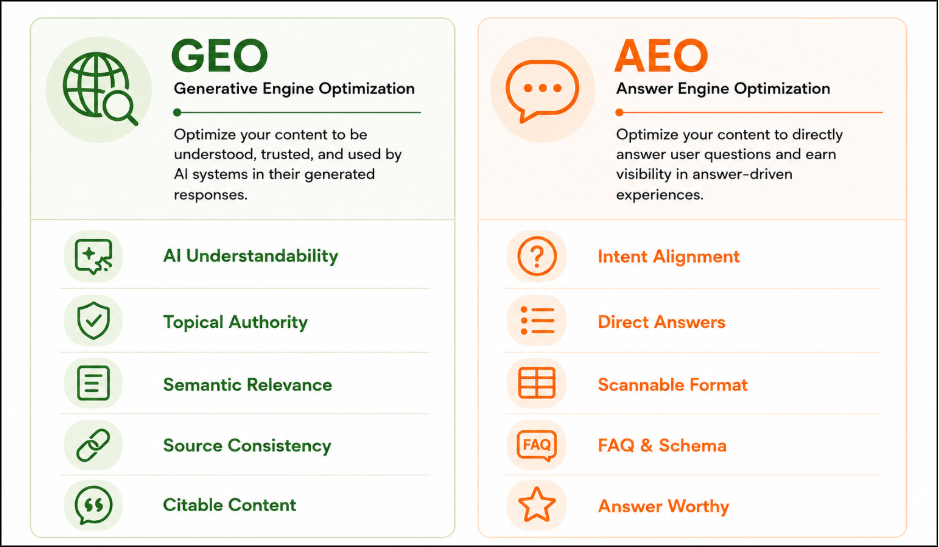
An efficient optimization model of AI-first search ought to concentrate on transparency, format, authority, and citation preparedness.
GEO & AEO Optimization Checklist
- Use question-based headings
- Provide a response to the general question at the beginning of each section
- Precisely define all important entities
- Add summary blocks
- Compare using comparison tables
- Write for humans first, but structure for machines
- Include FAQ information which might support schema
- Add professional commentary and analysis
- Build internal links to related OC resources
- Support arguments that have authoritative references
- Publish specific, not generic content
The guiding principle is straightforward: in case an AI system were to decide on whether your page should be cited, would your content make a quick and clear argument?
What Content Performs Best in AI-First Search?

A combination of utility and originality of content is generally the strongest content in AI-first search.
That includes:
- Frameworks
- Step-by-step guides
- Comparisons
- Explainers with strong definitions
- Data-backed insights
- Expert commentary
- Case studies
- Original research
- Clear FAQs
Information that only reiterates already existing information will not do well. However, content that introduces a new perspective, new information, or an improved format is more likely to gain traction.
For example, imagine two articles answering the same question:
“How do I improve my website’s SEO?”
One article provides a basic list of tips that can be found on hundreds of other websites. The other includes a step-by-step process, real examples, screenshots, and insights based on actual experience.
While both answer the question, the second article offers more value and originality, making it more likely to be surfaced, cited, and trusted in AI-driven search experiences.
In other words, AI-first search does not reward more content. It rewards better content.
Will AI Search Reduce Website Traffic?
Yes, on most sites, particularly those created on straightforward information queries.
However, the effect will not be homogeneous.
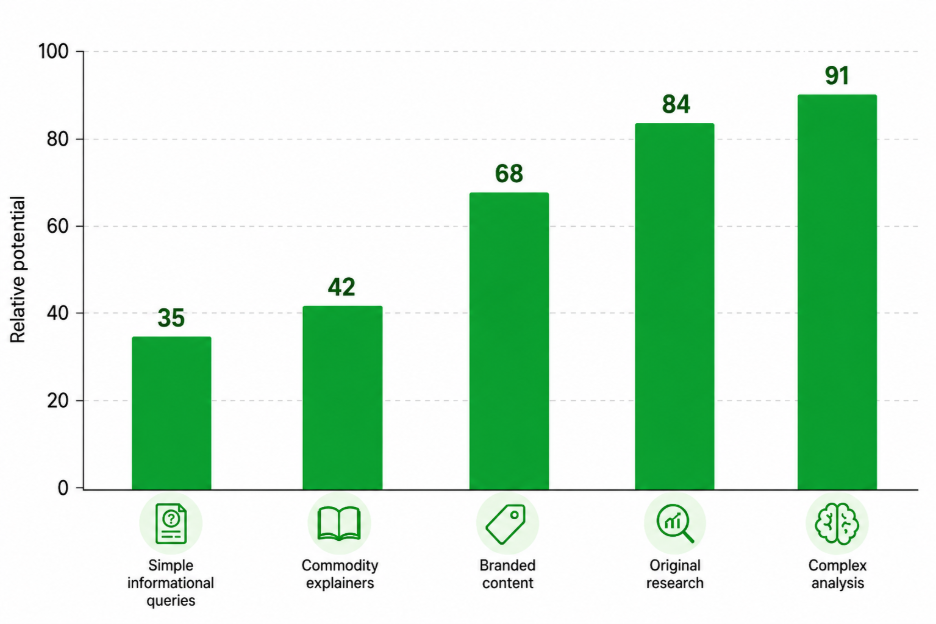
Early research on Google’s AI-generated search experiences suggests that answer-first interfaces can reduce visits to original content providers by satisfying user intent directly within search results. The effect appears strongest for simple informational queries, while pages offering unique expertise, original research, or complex analysis remain more likely to attract clicks and engagement.
Most of the traffic may decrease because of:
- Broad, general informational pages
- Thin affiliate content
- Commodity explainers
- Duplicated SEO pages that lack originality
Traffic can be more accommodating to:
- Branded content
- High-intent commercial pages
- Unique research
- Strong editorial pieces
- Pages where the answer is to complex, layered questions
The less content there is to be lost in summing it up, the more dangerous it is. The greater the original insight, evidence, or usefulness of your content, the more justifiable it is.
What Should Businesses Do Next?
The businesses that will retain visibility aren’t the ones who react fastest — they’re the ones who already have content worth citing. That’s the audit every team should run today.
Start by looking at your existing content through a single lens: would an AI system cite this, or summarize past it?
That means asking harder questions than most teams are comfortable with:
- Which pages answer a specific question better than anything else on the web?
- Which pages are generic enough to be fully replaced by a two-sentence AI summary?
- Where does your brand hold genuinely original data, experience, or perspective?
- What needs to be consolidated, updated, or retired before it dilutes your topical authority?
The pages that survive AI-first search aren’t the ones optimized most aggressively — they’re the ones that carry information an AI can’t generate on its own: proprietary research, real case outcomes, expert-level analysis, and structured answers built on actual experience.
Beyond content, this also demands tighter alignment between SEO, content, and brand teams. Technical SEO alone can no longer carry visibility. In AI-first search, structural clarity, topical authority, and content quality work as a single system — not separate workstreams.
The organizations that adapt will stop treating search visibility as a ranking problem and start treating it as a trust problem. Rank is a byproduct. Trust is the strategy.
FAQs
1. What is Google’s Intelligent Search Box?
It’s Google’s redesigned search interface built to handle longer, conversational prompts and AI-generated responses — not just keyword matching. The practical shift is that Google is now trying to understand what you’re trying to accomplish, not just what you typed.
2. Does traditional SEO still matter?
Yes, but it’s no longer sufficient on its own. Technical SEO, crawlability, and page structure still form the foundation. What’s changed is what gets built on top of that foundation — topical authority, citation potential, and content that AI systems can actually use to construct answers.
3. How do you measure visibility in AI Overviews and AI Mode?
This is one of the genuinely unsolved problems in the industry right now. Traditional rank tracking doesn’t capture AI citation frequency. Teams are beginning to use brand mention monitoring, prompt testing across AI tools, and referral traffic from AI platforms as proxy signals — but standardized measurement is still catching up to the reality.
4. Is GEO relevant for small businesses, or only large brands?
It’s arguably more urgent for smaller brands. Large brands often get cited by default due to existing authority. Smaller businesses need to be exceptionally clear, specific, and structured to compete for citation space. Niche topical authority — owning a narrow subject area completely — is one of the most viable paths.
5. How quickly is this shift happening?
Fast enough to act on now, but not so fast that everything changes overnight. AI Overviews are already affecting click-through rates on informational queries. AI Mode is expanding. The businesses that start auditing and repositioning their content today will have a measurable advantage within 12 months over those that wait.
6. What’s the single most important thing a content team can do right now?
Run a citation audit. Go through your top 20 pages and ask honestly: does this page contain something an AI couldn’t generate on its own? If the answer is no for most of them, that’s where the work starts.
Future of Organic Visibility
Google’s intelligent Search Box isn’t just a new interface. It’s a signal that the rules of visibility have been rewritten.
For the past 25 years, organic visibility meant ranking. You optimized pages, earned links, and competed for position on a list. That game isn’t over, but it’s no longer the only game, and for many query types, it’s no longer the most important one.
The new visibility is earned differently. It comes from being the source an AI system reaches for when constructing an answer, not because you ranked highest, but because your content was clearest, most specific, and hardest to replace.
For SEO teams, that means shifting from ranking as the goal to trust as the strategy. For publishers, it means protecting source value over traffic volume. For brands, it means treating your content library as infrastructure something AI systems can rely on, not just something users can find.
The future belongs to sources, not just sites.
The search box changed. The question is whether your content did too.

About the author: Steve M
Steve M is a digital marketing strategist and SEO expert specializing in Google's search algorithms and AI-driven technologies. He helps businesses adapt their SEO strategies to stay ahead of Google's latest updates, including AI Mode and intelligent search features. His actionable insights empower brands to maintain and grow their organic visibility in the ever-changing world of search.


