

Fresh is a common word you might’ve heard in your day-to-day lives often. Whether you’re at a fruit vendor asking for fresh fruits or at a restaurant asking for fresh food, everybody wants everything fresh.
A common term here, or you can say a common requirement, is fresh.
The same goes for the content. It’s obvious that no one wants to see the same content again and again, whether it’s on a social media platform or a particular website on the internet.
However, the main problem for businesses is that they expect to get top ranking and greater visibility with their stale, outdated content.
Nonsense, right?
Due to this reason, they’re always left in the shadows of their competitors, who use a secret recipe mixed with fresh content as their main ingredient to get higher rankings.
Well, now you’re curious enough to want to know more about this secret recipe, right?
Hold your calm because we’ll be discussing this recipe in detail below so that you can become that chef who cooks fresh content on the pallet of rankings.
How Can Content Be Fresh, Though?
Fresh content?
What exactly is fresh content?
Is it a magical potion that Google drinks to help you get higher rankings?
Well, you might be a little close, but not quite right!
Still not sure?
Basically, fresh content means constantly adding new content or updating your site with new information. However, just don’t add content for its own sake. Since relevance is a major factor when it comes to Google ranking, you should always add relevant content to your site.
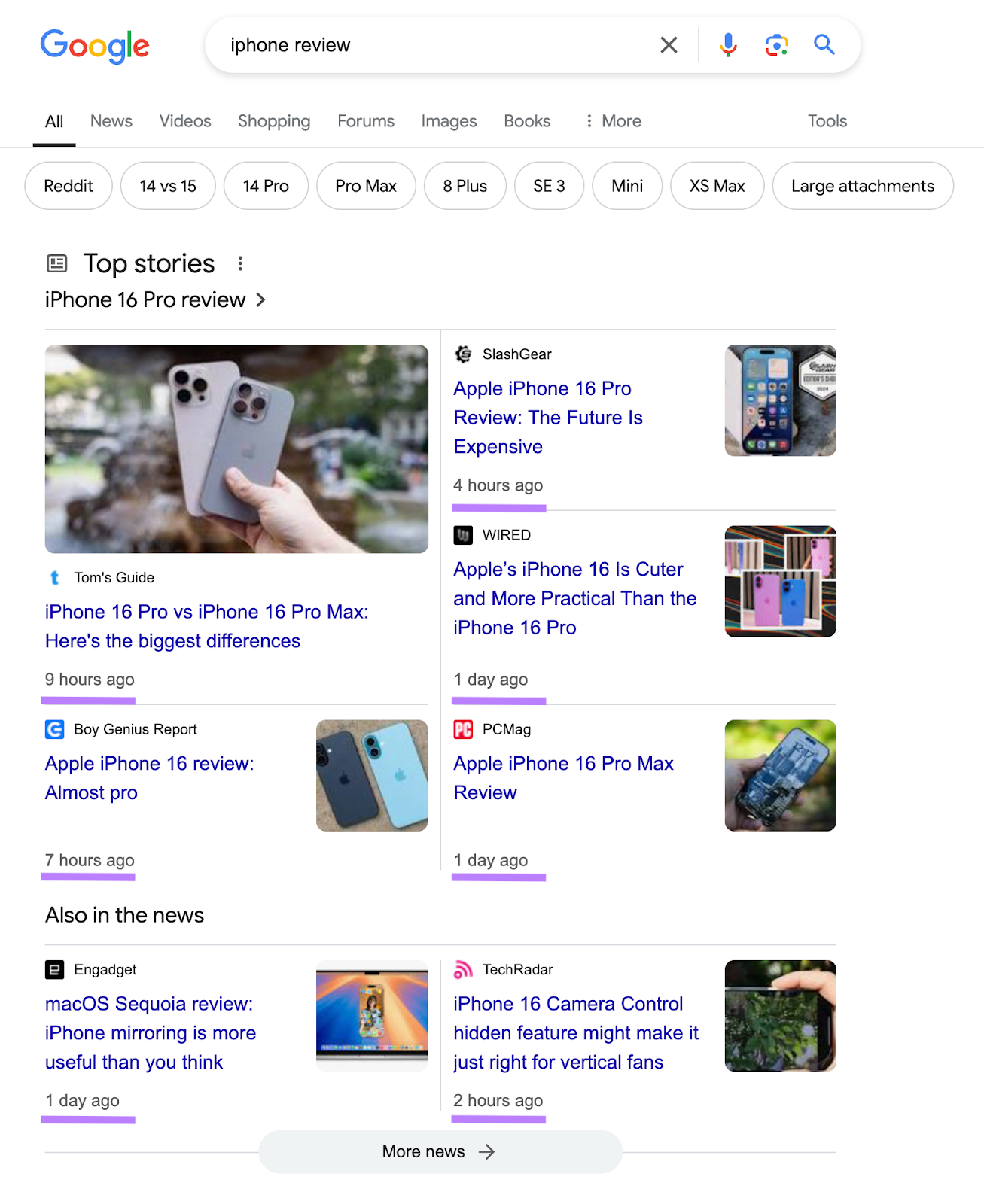 semrush.com
For example, in the above image, the most significant factor is relevance and time sensitivity. The relative recency of an article is often viewed by Google and other search engines as an indication it contains quality information because the information provided is the most up-to-date.
Why Fresh Content Matters for SEO
Original content affects your search engine positioning directly. Google prefers fresh sites with fresh, often updated, and relevant information.
Here are a few key reasons why fresh content matters for SEO.
- Boosts Visibility: To enhance visibility, search engine crawlers revisit your site, picking new or updated content for indexing.
- Improves Keyword Rankings: When you target popular keywords and topics, you are more likely to target high overall search terms depending on your specialization.
- Encourages Engagement: The quality of the content can affect the engagement of the audience; people love to share opinions on the fresh content available on the internet.
- Builds Authority: Google favors any site that shows proper authority in a given niche. Creating new content frequently contributes to increasing your website’s credibility as a source of information on the chosen topics.
Google’s Content Freshness Algorithm
Google has employed a freshness algorithm that ranks websites in search results that they believe should be higher for the given query. This algorithm compares how far back the page has been updated and how updated the contents that are present there are.
The underlying concept is relevancy: searchers need up-to-date, accurate information, be it news, innovations, trends, etc.
There are two main factors that influence Google’s freshness algorithm:
- Recency of Content: Google gives preference to how often a page or article has been updated or even published.
A study by Backlinko showed that The Google Caffeine update prioritizes newly published or updated content, particularly for time-sensitive queries. Google highlights the relevance of this element by displaying the date of a page’s last modification for specific pages.
 backlinko.com
In regard to more specific topics, which require up-to-date information, such as news or the latest trends, newer resources will appear at the top of the list.
- Quality and Relevance: It is not enough to just produce content so that the content is perceived as new. Google prioritizes recent links that are of high quality, informative, and, most of all, relevant to the search statement.
How to Create Fresh Content That Ranks
Now that we know the value of freshness let’s turn the discussion to how to create content that is as fresh as it needs to be while also being optimally search engine-friendly.
A. Identifying Trending Topics
Just as an author needs to read newspapers to be aware of current topics, you need to be familiar with topics occurring in your specific field. Using HubSpot, BuzzSumo, and Answer the Public, you will find out what people are currently looking for on the web.
 hubspot.com
These tools help unveil what is trending and consequently help you generate content that may go viral. When you write content concerning topics of interest at the time, you are in a position to capture many readers looking for that information.
B. Repurposing Old Content
Repurposing is one of the best strategies to keep your site relevant and updated without establishing a new site from the start. Take a look at your high-performing pages and articles and consider ways to update them:
- Infuse new statistics or new case studies.
- Synchronize product information that is out of date.
- Add more multimedia, such as videos and infographics.
- Rewrite the text with the most appropriate structure so that it is easy to read.
In addition to keeping your website updated on a regular basis, repurposing existing content maintains page authority and important inbound links.
C. Focus on E-A-T (Expertise, Authoritativeness, and Trustworthiness)
E-A-T is one of the concepts Google uses to measure the quality of the site. The websites with more E-A-T scores will rank better.
When creating fresh content, consider the following:
- Expertise: Make sure that the content is created by professional individuals.
- Authoritativeness: A visitor must perceive your website as a source of information on the given topic.
- Trustworthiness: Encourage the usage of credible sources, include links to relevant websites and make the website highly accessible.
Thus, increasing the E-A-T of your content means increasing the likelihood of new content ranking well in search results.
On-Page SEO Best Practices for Fresh Content
 hubspot.com
Search engine optimization should not be left out when creating fresh content for your station. Here are some on-page SEO best practices that can help your fresh content rank higher.
A. Keyword Research and Optimization
Keyword research is the first step to approaching search engine optimization. For example, keywords for fresh content can be found using Google Keyword Planner, SEMrush, or Ahrefs tools. Ensure that your target keyword is placed in strategic positions.
- The title tag
- Meta description
- Heading tags (H1, H2, etc.)
- URL
- Within the content (naturally)
However, don’t over-optimize. Keyword stuffing is bad for your rankings.
 semrush.com
This is what a page with stuffed keywords looks like, so make sure you add keywords accordingly.
Add related terms known as LSI (Latent Semantic Indexing) keywords for context in the content created.
B. User Experience (UX) Cues
Information presented in Google Ranks says that the company takes user experience into consideration when ranking pages. The clearer your website structure and navigation, the better your ranking. For fresh content, this includes:
- Instant access and quick loading time can be checked on Google PageSpeed Insights
- Mobile accessibility (make sure the content is usable on the latest mobile platforms)
- Usability (your site must be easy to use, ensuring that the pertinent content is easy to find and access)
C. Internal and External Linking
Internal links allow your website users to get around easily, and Google bots can also easily crawl and index your pages. When creating new content from scratch, do not forget to connect the website’s different pages.
External links to reliable, authoritative sites further increase your content’s reputation, which can also help it rank higher. Ensure the external links are pertinent to the text and point to reliable websites.
How Often Should You Publish Fresh Content?
Regarding the frequency of publishing new content, there is no one-size-fits-all solution. Consistency is crucial.
Publishing once a week, twice a week, or even once a month might be effective, depending on your company and available resources. However, the more often you post high-quality content, the more opportunities Google has to rank it.
Regular content updates are essential for news websites and blogs. Other websites, particularly those that are instructional or e-commerce sites, could require fewer modifications as long as the content is consistently updated and improved.
Content Updates vs. Completely New Content
Occasionally, upgrading already existing content is enough to keep it fresh. In other cases, you might have to provide entirely own content. When to do each is as follows:
- Update Current information: Make necessary changes to information that is still effective and relevant (e.g., fresh data, updated trends).
- Produce New Content: Produce new content from the ground up if the subject has changed substantially or if you need to target a different keyword or audience.
Tracking the Success of Fresh Content
Keep an eye on a few crucial criteria to gauge the effectiveness of your new content.
- Organic Traffic: To monitor the amount of organic traffic your new content brings in, use Google Analytics.
- Keyword Rankings: Monitor your desired keywords’ success over time.
- Engagement Metrics: To measure user engagement, examine time on page, bounce rate, and social shares.
- Conversion Rates: Track how successfully your content converts visitors if your objective is to generate leads or sales.
Common Mistakes to Avoid
When producing new content for SEO, there are a few typical traps to avoid, even with the best intentions.
- Neglecting Quality: Avoid compromising quality in favor of quantity. Make sure your information is accurate, valuable, and thoroughly researched at all times.
- Not Considering User Intent: Provide content relevant to the purpose of users’ search queries. Offer a solution if that’s what they’re seeking.
- Absence of Regular Updates: Regular updates are required. Neglecting your website might result in a decline in ranks.
Making Fresh Content Part of Your SEO Strategy
Fresh content is essential to a successful SEO strategy, not simply a nice-to-have.
You may raise your website’s exposure, traffic, and rankings by producing new, pertinent content that speaks to user intent, optimizing it for search engines, and updating it frequently.
To keep your competitive advantage, stay up to date on trends, update outdated content, and put the user experience first at all times.
Prioritizing fresh content will put you on the path to SEO success.

About the author: Vibhav Gaur, Business Head
Vibhav Gaur leads strategic operations and business growth at the organization. With a strong background in digital transformation and customer-focused solutions, he has helped numerous clients streamline their web presence and scale efficiently. His leadership ensures seamless execution across teams, with a commitment to delivering results and fostering innovation in every project.


